
Q & A
Amateur Radio Q & A
Q & A
Amateur Radio Q & A
Q & A for ham beginners
What are the preparations required for Ham HF communication?
What does it mean to ground the antenna?
What does it mean to adjust the SWR of the antenna?
My own ham station antenna grounding and SWR adjustment experience?
Introducing antenna ground installation in Apaman environment as an example
What are the preparations required for Ham HF communication?
A radio that can perform HF. If possible, an HF / 50MHz all-mode radio or an HF / 50MHz / VU all-mode radio and antenna, he needs an antenna tuner and ground, and a SWR meter if needed.
Antennas such as HF require grounding.
What does it mean to ground the antenna?
"The antenna is either a type that requires grounding or a type that does not. For types that are not needed, the condition will not improve just because they are grounded. The type that requires grounding will not operate normally without grounding.
Antennas are for radiating and receiving electromagnetic waves, and there are various types such as balanced type and single type. Dipoles and Yagi antennas are balanced with the ground and do not require grounding, but for example, a ground plane with a length of λ / 4 has a mirror image (image) with the ground as a boundary and is a vertical dipole of λ / 2. It can be considered to work the same.
Therefore, a good ground is required for high-frequency current to flow in. You can use a ground with a copper plate buried in the ground to ground the antenna, but in reality, by connecting an electric wire with a length of λ / 4 to the ground side of the feeding point (the outer skin side of the coaxial cable), a high-frequency ground Let it play the role of (earth). This is called radial.
In the case of a ground with a copper plate embedded in the ground, there is inevitably a ground resistance, which directly leads to high frequency loss and reduces radiation efficiency. By attaching a radial to the antenna, the efficiency will be greatly improved, the matching (suction) of the transmission output to the antenna will be improved, and the radio wave will fly better. In addition, the antenna will operate according to theory, the performance at the time of reception will be improved, and the S / N ratio may be improved.
Most antennas do not require such a high frequency ground, but may be required for non-radial ground planes or mobile whips.
In summary, some types use ground as part of the antenna, and for such antennas, use ground or a radial alternative to electrical ground for normal or complete operation. It means to do.
References: Yahoo! Japan Chiebukuro "What is the effect of antenna grounding?"
What does it mean to adjust the SWR of the antenna?
SWR, also called "matching", is a value that represents the matching state of the antenna. The radio wave from the radio to the antenna is called the traveling wave, and the radio wave flowing back from the antenna is called the reflected wave, which is the value of this ratio.
The closer the SWR value is to 1, the better the matching state (matching is better), and the more efficiently the radio waves are emitted from the antenna.
Generally, for amateur radio, adjust with SWR 1.5 or less. Even if a high-performance antenna is used, if the SWR value is high, not only will the radio wave skipping worse, but it will also be one of the causes of radio interference. Also, please note that the radio may be overloaded and may break down.
For HF band and 50MHz band antennas, even if the antenna is made by a manufacturer, it is necessary to adjust the element and radial according to the operating frequency. Use an SWR meter or antenna analyzer for adjustment.The antenna analyzer has a built-in transmitter and frequency counter that are ideal for measuring the SWR, impedance, and return loss of 50Ω equipment, and is fully effective in checking the antenna, making it convenient for maintenance and inspection.
Some radios are equipped with an "auto antenna tuner" function, but it is not necessary to adjust the antenna, and the antenna tuner is for fine adjustment only, so if you adjust the antenna properly, the radio waves will fly better. ..
Reference: Musen ZONE25 "Let's enjoy the 50MHz band from OM to beginners!"
My own ham station antenna grounding and SWR adjustment experience?
Authorities' experience: Radio + antenna SWR adjustment + use of antenna tuner + grounding of counterpoise connection. HF 3.5MHz, 7MHz, 21MHz, 28MHz and VU 50MHz, 144MHz, 430MHz can now receive ham communication.
It is now possible to communicate with HF / 50MHz / 144MHz SSB and 430MHz / 1200MHz FM.
I used to have a radio that could get 430MHz out of HF. However, ham communication was possible only at 430MHz. However, other bands such as HF could not receive or communicate.
However, I attached a counterpoise as a ground and adjusted the SWR of the antenna. I adjusted it with the antenna tuner before communication. Then, at my own ham station, I was able to receive HF and so on. Also, you can now receive other bands. And at my own ham station, I've also been able to communicate in other bands and modes of ham. The counterpoise served as the ground for the antenna. The antenna has been adjusted so that the radio waves are output optimally. I have improved Ham's communication status than before. I was full of gratitude.
Introducing antenna ground installation in Apaman environment as an example
My own amateur radio station is Apamanham (amateur radio station living in an apartment). It seems that it is environmentally impossible to install a large antenna with a narrow balcony. For that purpose, we use a mobile whip antenna as an antenna for amateur radio.
Previously, I couldn't figure out how to do it, and I raised the 430MHz antenna and managed to receive and communicate with FM only in that band for a long time. After the amateur radio reopening station in 2020, I managed to improve the situation and aimed to be able to operate other bands, HF, and SSB. I searched hard for online information, YouTube amateur radio related information and technical books. Also, the reason why the good results were obtained was that we were able to improve the operating environment by joining the club and receiving support from the club's seniors.
So, in the case of Apaman Ham, I learned that there is a counterpoise installation method as one method of grounding the antenna. We have a commercially available counterpoise (CQ ohm counterpoise is convenient), HF / 50MHz and 144 / 430MHz antenna tuners, and SWR meter. The radio FT-991AM also has a built-in HF / 50MHz auto antenna tuner. I bought the FT-991AM after getting the advanced qualification. Until then, I used a manual antenna tuner and SWR meter before amateur radio communication. When using it, I used either a manual antenna tuner or a radio auto antenna tuner. Also, the FT-991AM did not come with a built-in antenna tuner for 144 / 430MHz, so I still use the manual antenna tuner. When communicating at 50MHz etc., I adjust the SWR with a manual antenna tuner instead of the antenna tuner built into the radio. Then, I had the experience that the signal report of my own ham station was uploaded. I also found the manual antenna tuner to be convenient to use. Then, I used a SWR meter to adjust the antenna of each band so that the SWR was minimized to the frequency that is often used in that band. Also, before using the radio, I used an antenna tuner to suppress the SWR.
Then, surprisingly, I could only receive and communicate at 430MHz at the same place, but now I can receive and communicate at HF ??/ 50MHz / 144MHz / 1200MHz. I was very grateful.
In addition, if a qualification is obtained and high transmission output becomes possible, an internal use of a common mode filter will be installed in the room as a measure against radio interference. And for external use, it seems good to connect a common mode filter to the balcony. It also seems to be a noise countermeasure. In addition, it seems that it is good to wrap the cord of the power supply of the radio and the cord of the TV or the Internet modem on the patchon core etc. in the part where the radio wave is easily spread.
I'm sorry, but the grounding measures with this mobile whip antenna and counterpoise are just examples of measures, and they may not work depending on the place and environment in which they are used. In that case, please search for more information on the Internet and consider countermeasures. Please understand. Also, from the CQ publisher, "I want to enjoy it as easily as possible! A book called "Amateur Radio Antenna Easy Installation Know-how" has also been published, so I hope you will find it helpful.
In the future, I would like to aim for improvement so that the signal report of the authorities can be strengthened a little more. I still feel that it is necessary to improve the operating environment, and I would like to investigate further and take measures to improve the communication environment for amateur radio.
Measures to be taken when a ham beginner, etc. is pointed out or criticized by the ham station of the other party with whom he communicated
For ham radio, I think people with technical experience are great. It seems that there are various details, but it seems that there is a director of the ham station who points out and criticizes strangers. In order to use DX for HF communication, it may be necessary to install a ground on the antenna in some cases. However, I think that some amateur radio station beginners do not yet know that it is important to have a ground, so I would like to ask for a gentle response.
Also, about the amateur radio award. It seems that there are many awards among amateur radio stations that communicate with amateur radio in the HF band. I think that's a good thing. However, it seems that there are amateur radio stations that criticize amateur radio stations that do not issue QSL cards for that reason. I understand that collecting QSL cards is important. However, some ham stations that have not joined JARL do not issue QSL cards. I heard that there is a ham station that criticizes that it is better to stop amateur radio stations. Many amateur radio stations seem to accept NO-QSL. However, some ham stations of amateur radio stations are said to be criticized.
It was also mentioned in the net information. On YouTube, that was also pointed out by the young popular YouTuber of ham radio stations. According to one popular YouTuber, such weird people are about 1% of the amateur radio population. 99%, almost all ham radio stations were said to be harmless ham stations. However, according to the YouTuber, I have not met anyone who criticized it without issuing a QSL card. It seems that only three people in decades have imposed their personal opinions. However, the YouTuber seems to have no intention of quitting amateur radio for that reason. I'm addicted to the depth and fun of ham radio. But some people will hate it. He said that unlike work, people who dislike it can quit.
I understand that there is also a reason for the point of the Ham Bureau, which has been criticized in part. However, many amateur radio stations are not such ham stations. It is a pity that the criticized amateur radio stations will not be able to continue amateur radio and will quit the ham station. It will also lead to a further decrease in the number of amateur radio stations that are currently decreasing. I felt very disappointed that the number of amateur radio friends was decreasing. For amateur radio stations, I would like you to consider the position of the station that wants NO-QSL if possible.
It is a countermeasure plan when an amateur radio beginner or an ordinary amateur radio station is criticized by an amateur radio station. In that case, you don't mind and just pass by. That may make sense for the criticizing Ham's bureau. However, such people are found in every society. I want to understand that it is only a small part of the ham stations. I don't think I'll meet them all the time. Think of it as unlucky that day you met. It's a real shame for me to quit my hobby of ham, which has many ways to enjoy it. Let's pass by without worrying about it. We found it a good idea to enjoy communicating with many other harmless ham stations on a regular basis. Thank you. (May 31, 2021)
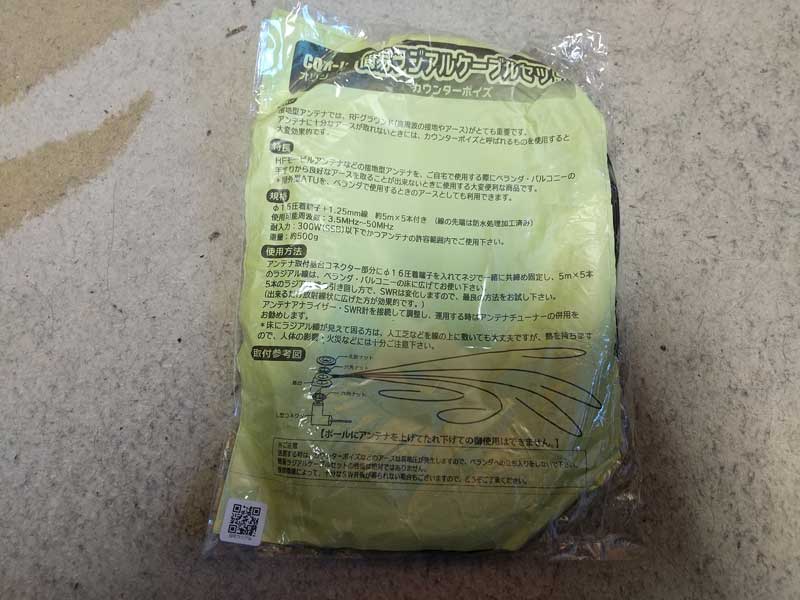
Counterpoise A
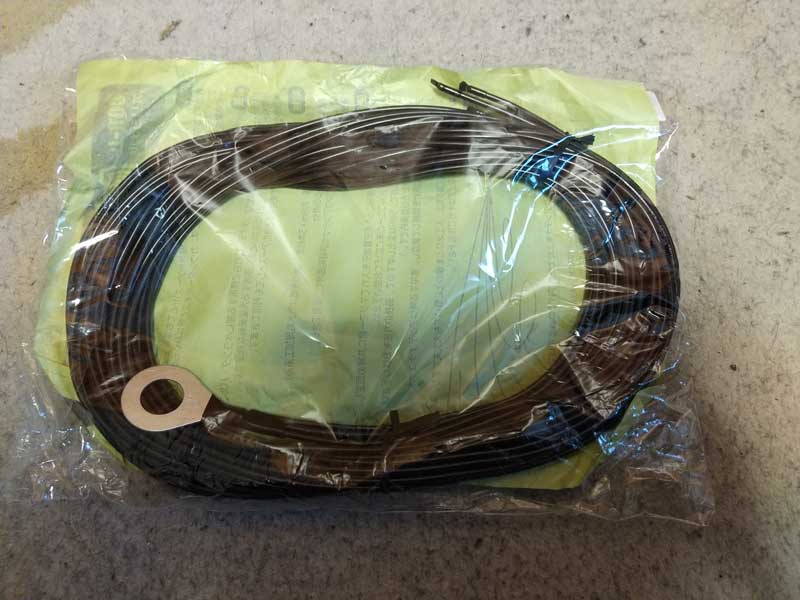
Counterpoise B
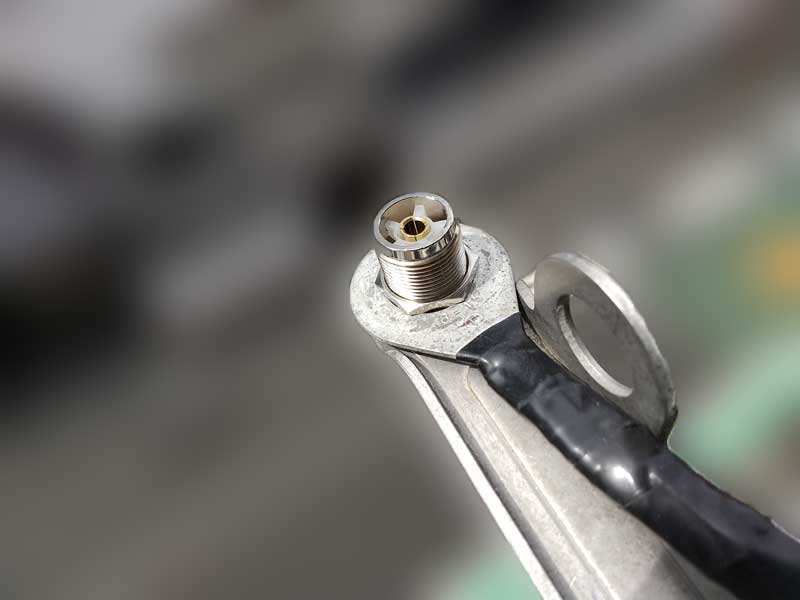
Antenna installation 01
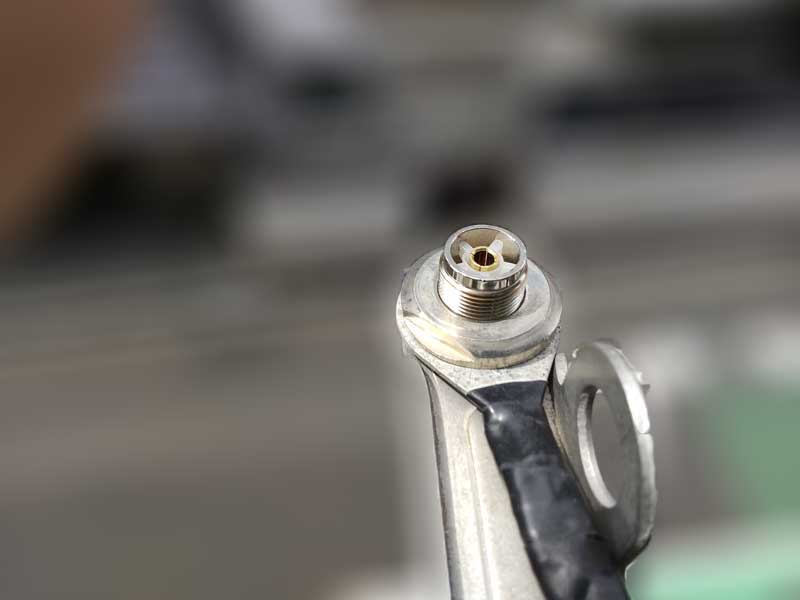
Antenna installation 02
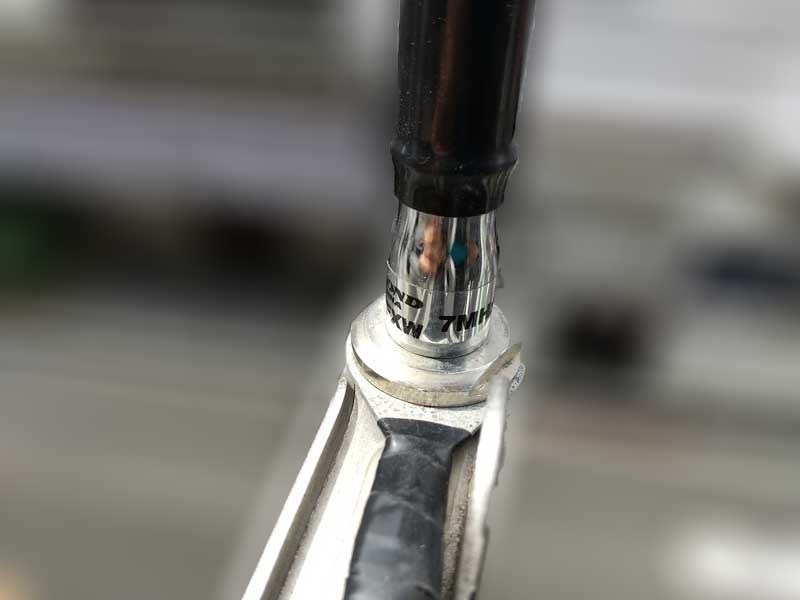
Antenna installation 03
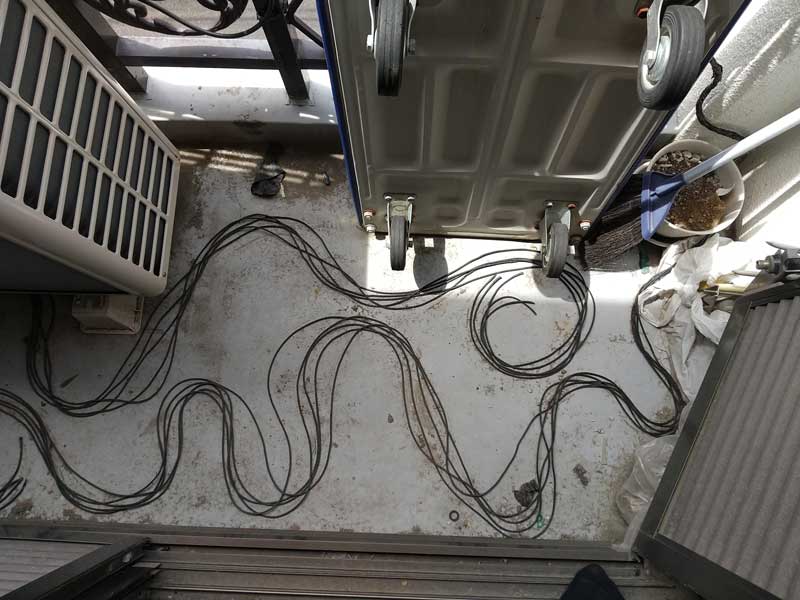
An example of the installation status of the counterpoise veranda
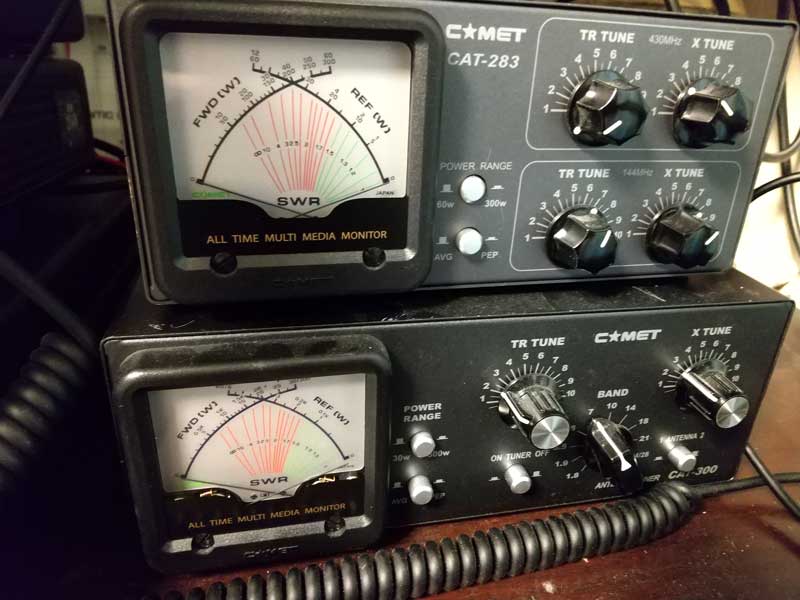
Antenna tuner

Common mode filter Interfair and noise suppression
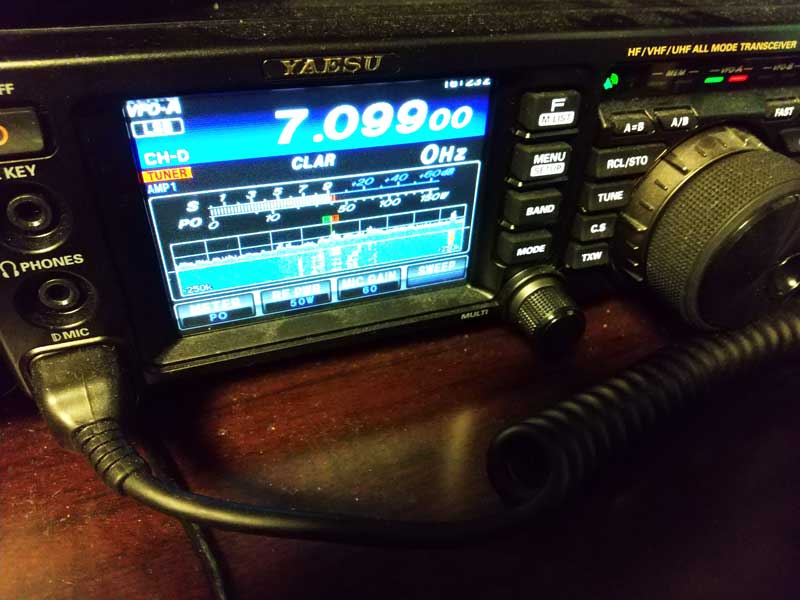
7MHz reception status one day
Copyright © APHamKAN